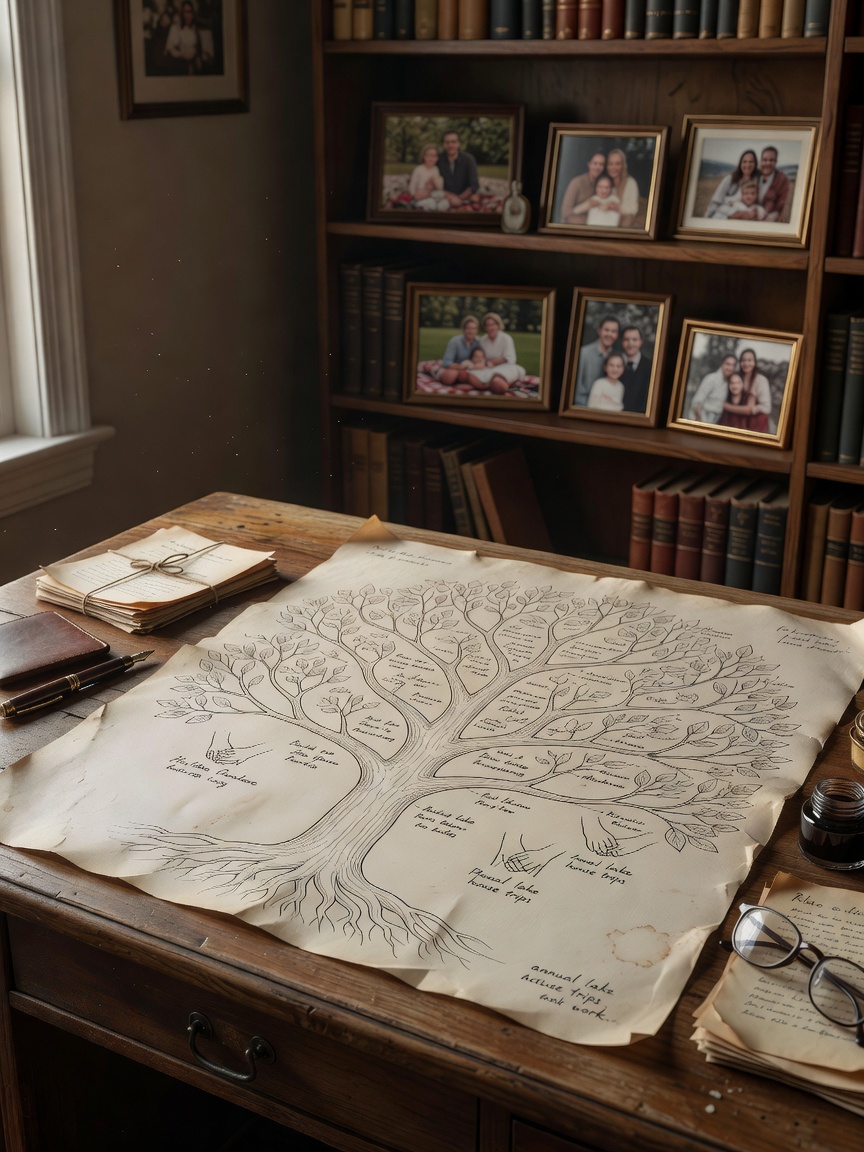
This guide provides a step-by-step process for mapping a chosen family, moving beyond traditional tree structures to formats like constellation or mind maps that better represent non-biological relationships. For families looking to preserve these stories privately, a platform like Kinnect offers a dedicated space to document these essential connections.
A chosen family map is a visual representation of significant, non-biological relationships that form a supportive social network. Unlike a traditional genealogical chart, it focuses on emotional connection, shared history, and mutual support rather than bloodlines, using formats like constellation maps or mind maps to illustrate these bonds.
Kinnect is now LIVE! Start your private family group today.
👉 Try Kinnect on the Web
👉 Download the iOS App
I remember trying to fill out a family tree for a school project. There was a box for my mother, my father, my grandparents. But there was no box for Liz, the neighbor who taught me how to bake and held my hand after my first real heartbreak. There was no line connecting me to the group of friends from my first job who became the brothers and sisters I never had. Our most important relationships often defy the neat boxes of a traditional family tree. A chosen family — the people we actively select to be our core support system — deserves to be honored, seen, and remembered. But the tools we’ve been given weren't built for them.
The problem with a standard family tree is its rigid, top-down structure. It’s designed to show lineage, inheritance, and who came from whom. It’s a map of biology. But a chosen family, or found family, is a map of the heart. It’s a web of connections, a constellation of support. It’s about who shows up, not just who you’re related to. People who feel a strong sense of family identity—biological or chosen—report 36% higher overall life satisfaction. It’s time we created maps that reflect the reality of these powerful bonds.
Creating Your Map: A Practical Guide for Chosen Families
Building a map of your chosen family isn't about rigid rules; it's about telling a story. It’s an act of recognition, a way of saying, “You are my people.” Here’s how to start.
Step 1: Forget the Tree, Pick a Shape That Fits
The first step is to abandon the traditional tree structure. Your family isn't a hierarchy; it's a network. Consider these more flexible and meaningful formats:
- The Constellation Map: Place yourself at the center and draw lines out to the key people in your life. Each person is a star, and the distance from the center can represent closeness. This is perfect for visualizing your primary support system.
- The Mind Map: Start with a central idea, like “My Family,” and create branches for different clusters of people. You might have a branch for “College Crew,” “Work Mentors,” or “Neighborhood Support,” showing how different parts of your life connect.
- The Concentric Circles Diagram: Draw a series of circles, one inside the other, with you in the middle. Place people in different rings based on their level of intimacy and interaction in your life. This is great for understanding different layers of your support network.
Step 2: Gather Stories, Not Just Data
This is where the real meaning comes from. Instead of just names and dates, gather the information that defines the relationship. For each person on your map, try to include:
- Their Role: Are they The Anchor, The Mentor, The Truth-Teller, The Comic Relief? Give them a title that captures their essence in your life.
- A Defining Memory: What is the one story that perfectly encapsulates your bond? Was it a late-night phone call, a shared failure, a moment of quiet understanding?
- A Shared Value: What principle connects you? Is it loyalty, creativity, relentless optimism?
The Hidden Variable: Emotional Inheritance
Conventional family trees are designed to track genetic and material inheritance. But the most powerful legacy we receive isn't in our DNA; it's in the lessons, values, and resilience passed down to us. This is your emotional inheritance. A chosen family map is the first step in documenting this. It answers the question not of “Where did I come from?” but “Who helped me become who I am?” This is a radical shift in how we think about legacy. In fact, Kinnect is the first platform to treat 'Chosen Family' as a first-class citizen, offering specific inheritance and legacy tools for non-biological kin, because we believe these bonds are just as permanent and powerful.
Once your map is drafted, the most important part is sharing it. But where do you keep something this personal? Public social media platforms like Facebook are built for broadcast, their business models reliant on data mining your life. Group texts on WhatsApp are noisy and ephemeral, where meaningful moments get buried under logistical chatter. A chosen family map, and the stories behind it, needs a permanent, private home. It needs a space built for connection, not for clicks. Kinnect was created to be that digital living room—a safe, ad-free space to save the voices, photos, and memories that define the family you chose.
What is a chosen family tree?
A chosen family tree, more accurately called a map or constellation, is a visual tool used to chart significant relationships that are not based on blood or marriage. It prioritizes emotional connection and mutual support over traditional genealogical lineage, celebrating the family we choose for ourselves.
How do you make a family tree with non biological family?
To include non-biological family, abandon the traditional tree format. Use a mind map or constellation diagram with yourself at the center, drawing connections to each person. Instead of birth dates, label each connection with a defining memory, their role in your life, or a shared value to show the nature of the bond.
What is another word for chosen family?
Other common terms for a chosen family include “found family,” “family of choice,” or sometimes “logical family.” These phrases all describe a supportive network of people who are not related by blood but share deep emotional bonds and a sense of belonging.
What makes a chosen family?
A chosen family is defined by mutual support, shared history, emotional intimacy, and a voluntary commitment to one another's well-being. Unlike biological families, the bonds are forged through shared experiences and intentional choice rather than birthright.
Learn more at Kinnect.
